Rephrased
An isometric linguistic puzzle adventure where rewriting ancient texts reshapes the environment around you.
Role
Design Producer
Team
10-members Design Team · ~45-person Development Team
Status
In production
Production Ownership
Design planning, task breakdown, scheduling, tracking, meetings
Tools


As the Design Producer for Rephrased, I oversee the day-to-day production operations of our 12-person design team. I translate our game macro and milestone requirements into actionable design tasks, maintain our weekly production plan, facilitate meetings, track progress, recruit and onboard designers, and coordinate dependencies with other departments. I also designed the structure of our ClickUp workspace, creating a centralized production system.
"
"


Designing the ClickUp Production System
Rephrased has an ambitious puzzle structure, where game is planned across five chapters, with approximately six to seven areas per chapter. Each area may contain several puzzles that introduce new runes, reinforce previously learned meanings, or combine existing mechanics in new ways.
My responsibility was to help turn that complexity into clear deliverables that the team could actually work from week to week.


5 Chapters
Areas
Puzzle Sets


Individual Design Tasks


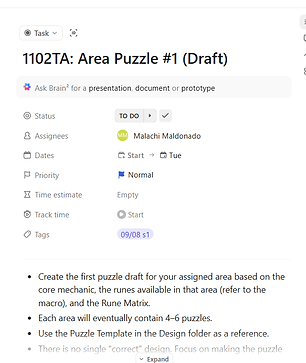

Status, Assignee,
Due & Priority

Task Details,
Descriptions, & Links
Sprint #
Structure & Navigation
Rather than simply creating a long task list, I organized the Click workspace and our shared google drive around the actual structure of the game and our production milestones.
Clarity
Designers should know exactly where their tasks belong.
1
2
Navigation
Information should be reachable without digging through conversations or unrelated folders.
Ownership
Every actionable task should have a clear owner.
3
Visibility
The Lead Designer and production team should be able to understand overall progress quickly.
4
Scalability
The structure needed to continue working as more areas, puzzles, and designers entered production.
5

The lead designer and director establish the broader creative direction and milestone goals. My job is to translate those goals into a production plan that designers can realistically execute. Throughout this project, I try my best to answer designer's questions like: what am I working on, when is it due, and where do I find the information I need?
Creating a Repeatable Production Rhythm
Because Rephrased contains many areas, puzzles, and interconnected design dependencies, I needed a system that gave the team both a high-level view of ownership and a clear understanding of what needed to happen each week.
Rather than relying on a single task board, our workflow uses two planning spreadsheets alongside ClickUp, with each tool serving a different purpose.

The Design Task Sheet acts as the team's high-level production map.
Each major area or game feature has a clearly assigned owner, allowing the team to quickly understand who is responsible for what across the game. This is especially important because ownership is a major part of how we structure design work on Rephrased.
The goal is to give designers ownership over a complete experience, rather than asking them to build isolated pieces of someone else's design.
Design Task Sheet
I designed this sheet for the lead designer to fill out, and determine assignments based on each designer's strengths, current area ownership, project priorities, and milestone needs.
My responsibility is then to take those assignments and translate them into a production-ready format in ClickUp.
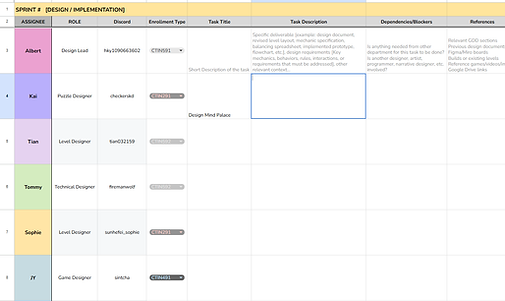
Weekly Deliverable Sheet
The Two-Week Sprint Structure
I also help maintain a consistent two-week sprint structure for the design team. Rather than designing and implementing everything simultaneously, we alternate between two different focuses:
Week 1: Design
Designers focus on developing the puzzle or feature itself.
Depending on the assignment, this may include:
-
Puzzle concepts
-
Rune interactions
-
Diagrams or flowcharts
-
Whiteboxing plans
-
Iteration based on Lead Designer feedback

Week 2: Implementation
The following week shifts toward turning those approved ideas into playable content.
Such as:
-
Building Blockouts
-
Testing in Engine
-
Refining Gameflow
-
Implement art assets

Monday
Sprint begins: New weekly deliverables are finalized, and I translate those assignments into ClickUp so each designer has a clear task for the upcoming week.
Tuesday
Design Team Meeting: Looking backward, we review the previous week's work. Looking forward, we then review the newly assigned tasks. This gives designers an opportunity to ask questions early in the week, rather than discovering ambiguity close to the deadline.
Thursday
Production checkpoint: the Lead Designer can also review work in progress and provide design feedback while there is still time to adjust direction.
Sunday
Final Checkin before Due: I check where each designer stands and help surface anything that may prevent completion. By Monday, we can then evaluate the finished deliverable and begin the next stage of the sprint.
Where We Are Now
Rephrased has now entered its production phase! My production system is continuing to evolve alongside the project. As new problems emerge, I adjust our ClickUp structure, weekly planning process, and communication workflows accordingly.
Throughout this project, I have learned that small gestures can make stressful production periods feel much more collaborative... Sometimes that means restructuring a task, sometimes it means checking in with someone privately, and sometimes it means buying the whole design team boba!🧋

< Key Takeaways >
A producer turns vision into something people can act on
The most important part of my role has been translating the Lead Designer's larger creative goals and our production macro into concrete assignments. A milestone only becomes useful when each designer understands what they personally need to accomplish.